



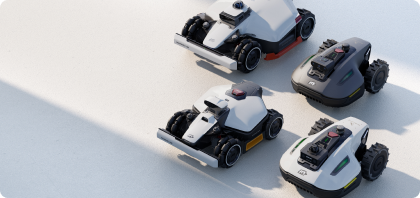

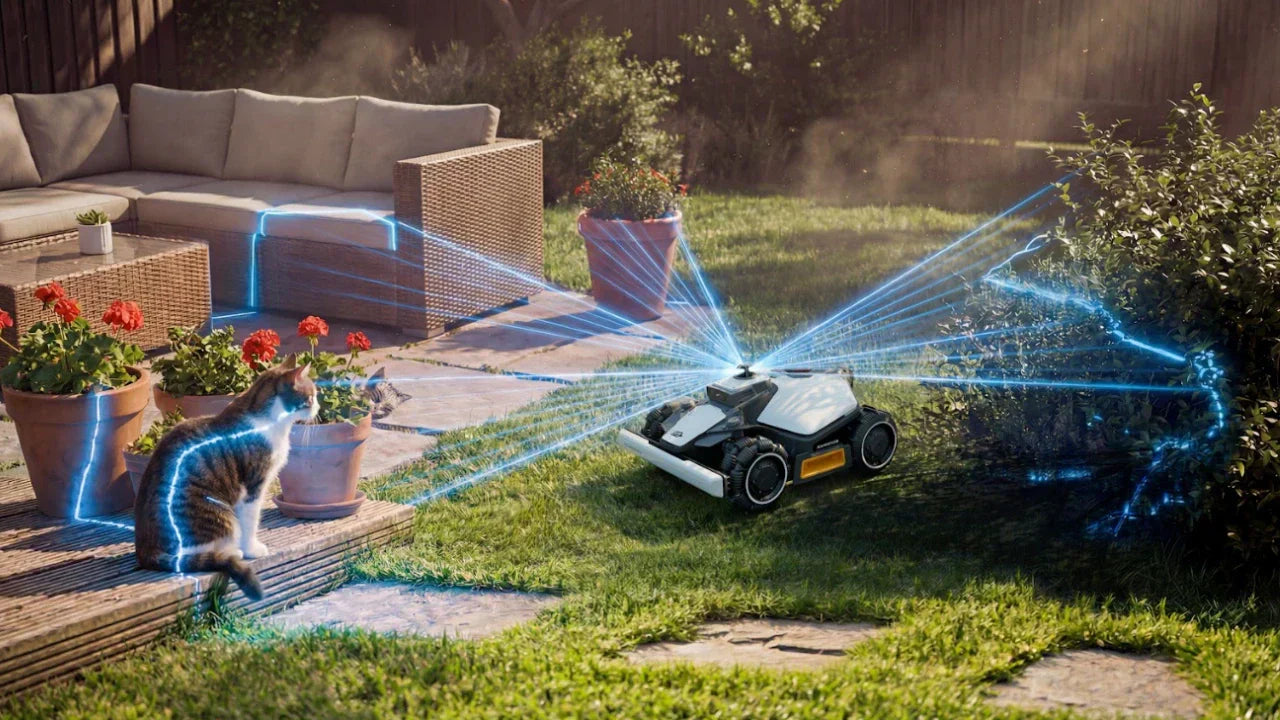
If your garden has complex terrain, traditional robotic lawn mowers often struggle to cope. The introduction of LiDAR technology, however, has completely transformed modern lawn care. In this guide, we take an in-depth look at the best LiDAR robotic lawn mowers of 2026, highlighting the most advanced and best-selling models on the market. We compare their navigation stability, obstacle avoidance performance, and mowing efficiency. Whether you have a small, medium, or large lawn, you’ll find the most suitable LiDAR robot mower for your needs here.
Best LiDAR Robot Mowers for Small Lawns
For small lawns, agility, a compact design, and the ability to handle narrow passages are especially important.
Comparison Table
| YUKA mini 2 1000 | MOVA LiDAX Ultra 1000 | |
|---|---|---|
| Max Mowing Area | 1000㎡ | 1000㎡ |
| Positioning & Navigation System | 360 LiDAR + Dual-Camera AI Vision (1080P) | 360° 3D LiDAR + AI Vision |
| Driving Engine | RWD | RWD |
| Max Slope Ability | 45% (24°) | 45% (24°) |
| Mowing area per charge | 250㎡ | 160-180㎡ |
| Charging Time | 135 min | 60 min |
| Mowing time per charge | 125 min | 60-80 min |
| Cutting Height | 20-60 mm | 30-100 mm |
| Cutting Width | 190 mm | 200 mm |
In-Depth Product Review
1. YUKA mini 2 1000
The YUKA mini 2 1000 combines 360° LiDAR with 1080P HD dual-camera AI vision. This setup enables centimetre-level positioning accuracy in both bright daylight and extremely low-light conditions, and allowing it to perform particularly well at detecting and avoiding small obstacles.

360° LiDAR Sensing, CM-Level Precision, Ultimate Durability
Full-coverage monitoring with 360° × 45° FOV, 60m long-range scan and 0.1m ultra-short blind zone. Total awareness in open lawns or tight corners.
IP67 waterproof and salt-resistant alloy shell protection, built to withstand heavy rain, physical bumps, and extreme weather for long-lasting reliability.
1.5cm high-precision detection with 144,000 pts/s sampling to ensure flawless obstacle avoidance and zero missed spots.
Dual-Camera AI Vision Recognition
Dual-camera AI vision recognizes different types of boundary and obstacles for an effortlessly smooth, intelligent cut. With integrated LED fill lights, the vision module enables seamless recognition and uninterrupted performance, even at night.
It navigates seamlessly through narrow paths and under trees with zero signal issues.
Higher Capacity, Longer Runtime
Capable of mowing up to 250 ㎡ per charge, it means YUKA mini 2 1000 mower can complete tasks with fewer returns to the charging station. The adaptive cutting height adjustment (25–60 mm) also allows it to create a carpet-like lawn finish with a higher level of mowing precision.

2. MOVA LiDAX Ultra 1000
Equipped with 360° 3D LiDAR and AI vision, the MOVA LiDAX Ultra excels at rapidly scanning surrounding physical features through laser-based sensing, making it especially fast in initial mapping and adapting to dynamic environments. Another major highlight of this model is its extremely fast charging speed — it can fully recharge in just 60 minutes. However, its runtime per charge is comparatively shorter.
Buying advice
- For small lawns, the YUKA mini 2 1000 offers longer runtime per charge and covers a larger mowing area, making it better suited for users who need frequent mowing during peak grass-growing seasons.
- Consider the complexity of your garden. Both models feature 360° LiDAR-based navigation systems. The MOVA LiDAX Ultra 1000 has a longer LiDAR detection range of up to 70 metres, compared to 60 metres on the YUKA mini 2 1000. However, the YUKA mini 2 1000 is equipped with dual 1080P AI vision cameras, providing enhanced environmental awareness and stronger obstacle avoidance performance, making it more suitable for gardens with more obstacles and complex layouts.
Best LiDAR Robot Mowers for Medium Lawns
Medium-sized lawns often include greater elevation changes and a wider variety of vegetation zones, placing higher demands on a robot mower’s drive system and obstacle avoidance redundancy.
Comparison Table
| LUBA mini 2 AWD 1500 | LUBA 3 AWD 1500 | Navimow i215 LiDAR 1500 | |
|---|---|---|---|
| Max Mowing Area | 1500㎡ | 1500㎡ | 1500㎡ |
| Positioning & Navigation System | 360° LiDAR + Dual-Camera AI Vision | 360° LiDAR + Dual-Camera AI Vision | LiDAR + AI Vision (140° RGB Camera) |
| Maximum LiDAR Range | 60 m | 70 m | |
| Driving Engine | AWD | AWD | 2 Rear Wheels |
| Max Slope Ability | 80% (38.6°) | 80% (38.6°) | 45% (24°) |
| Mowing area per charge | 500㎡ / per charge | 800㎡ / per charge | 426㎡ / per charge |
| Charging Time | 150 min | 90 min | 130 min |
| Mowing time per charge | 150 min | 135 min | 160 min |
| Cutting Disc | 2 | 2 | 1 |
| Cutting Height | Main disc: 20-65 mm; Edge disc: 50 mm |
25-70 mm | 20-70 mm |
| Cutting Width | 190 mm | 400 mm | |
| 4G DATA | 3 year free | 3 year free | 1 year free Renewable Annually at €29.9 |
| Price (€) | €1599 | €1999 | €1399 |
In-Depth Product Review
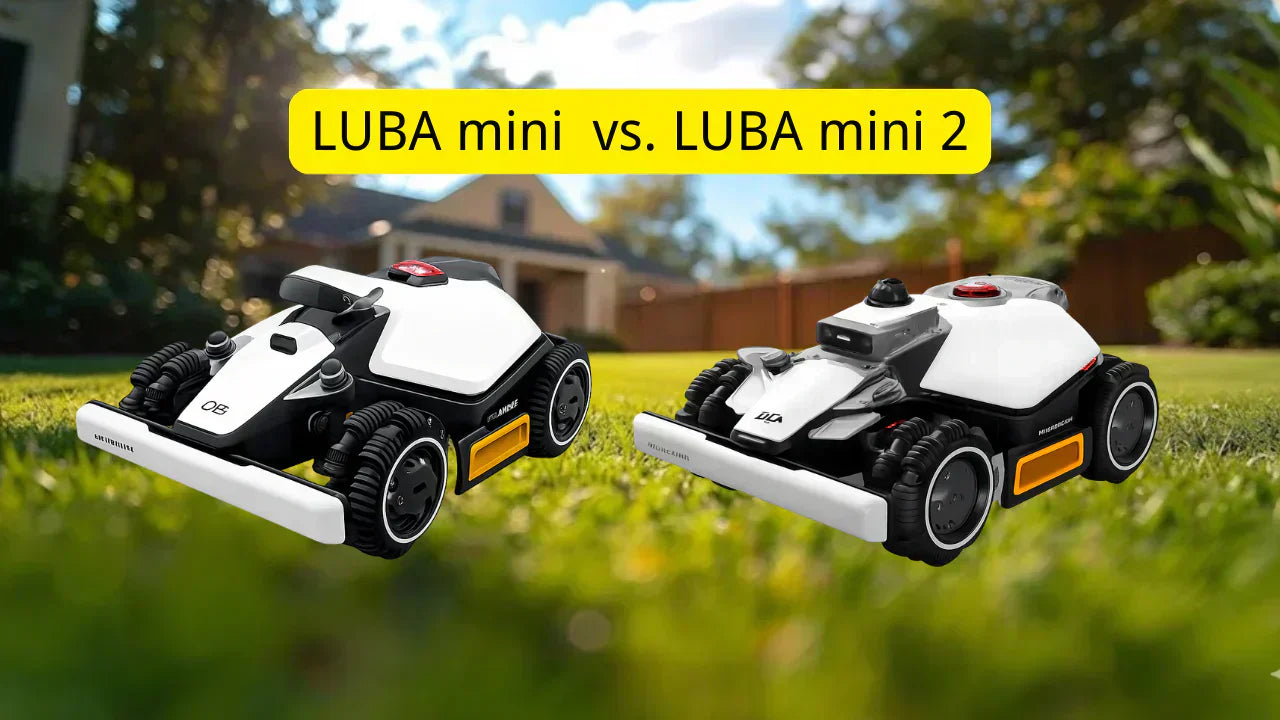
1. LUBA mini 2 AWD 1500
Experience full-surround LiDAR scanning with a 60m/200ft range and 360° × 45° field of view, generating 200,000 points per second, not just front-facing detection. Combined with Dual-Camera AI Vision, LUBA mini 2 1500 delivers centimeter-level navigation across your 1,500 ㎡ garden, effortlessly handling trees, narrow paths, day or night.

Seamless 360° Mapping, No Blind Spots
360° LiDAR captures every corner of your garden with no blind spots, ensuring complete and accurate maps even in tight corners, under trees, or near obstacles, reliably in every situation, whether under trees, in narrow paths, or at night.
Fixed 12cm Edge Cutting Disc
The fixed 12cm edge cutting disc ensures LUBA can mow up to approximately 5cm from walls safely, delivering precise edge trimming. When it rides along the edge, the edge disc ensures an even cleaner and more uniform finish.

AWD Conquers 80%(38.6°) Slopes
The LUBA series’ proven AWD design and power has won the trust of hundreds of thousands of households and continues to be used today. Combined with 360° LiDAR navigation, it can handle nearly any terrain up to 1500㎡ with ease.
Mow Smart, Mow Safe
With 360° LiDAR and dual-camera AI vision, LUBA detects and avoids 300+ stationary or moving obstacles in your garden, ensuring complete protection for your plants, furniture, and pets while mowing.
With 32cm main and edge cutting discs, AWD, and a 6.1 Ah battery, LUBA can mow up to 500 ㎡/per charge, efficiently covers 1500㎡ lawns.
If you are interested, please continue to read LUBA mini 2 AWD 1500 overview.
2. Mammotion LUBA 3 AWD 1500
If you require even more precise and stable navigation, along with higher mowing efficiency, then upgrading to the LUBA 3 AWD 1500 is the right choice.
With a sweeping 360° * 59° LiDAR view and a range of up to 70 meters, LUBA 3 AWD captures your entire yard with extraordinary precision. Millions of laser returns are transformed into a dense, real-time point cloud that maps everything from ground level to tree canopies and enabling it to handle even the most demanding lawns.

If you are interested, please continue to read LUBA 3 AWD overview.
3. Navimow i215 LiDAR 1500
The Navimow i215 LiDAR 1500 combines a 140° ultra-wide-angle RGB camera with LiDAR fusion, delivering reliable performance in detecting everyday obstacles such as small animals and garden toys. However, its hill-climbing capability (45%) and mowing efficiency (426 ㎡ per charge) are lower than those of the LUBA series, making it less suitable for complex terrain lawns.
Buying advice
- If your lawn includes steep slopes or uneven terrain: the LUBA mini 2 1500 and LUBA 3 AWD 1500 are both reliable choices. Their AWD drive systems provide unmatched traction on challenging surfaces.
- If you prioritise fast mowing and want the robot to minimise time spent moving across the lawn: choose the LUBA 3 AWD 1500. Its 400 mm ultra-wide cutting deck and up to 800 ㎡ coverage per charge outperform most competitors in its class.
- If you are on a limited budget: the LUBA mini 2 AWD 1500 offers excellent value among LiDAR robotic lawn mowers for mid-sized lawns.
Best LiDAR Robot Mowers for Large Lawns
For large lawns (up to 5000㎡), mowing efficiency becomes the most critical factor. At this level, a high-capacity battery, ultra-wide cutting path, advanced positioning accuracy, and intelligent route planning are essential capabilities.
For large lawns, Mammotion offers two of the best LiDAR robotic mower solutions on the market — and not just LiDAR alone.
Mammotion LUBA 3 AWD series (3000 & 5000)
As the flagship models in the Mammotion LUBA family, the LUBA 3 AWD series represents a leading solution for large and highly complex lawn management.
World's First Tri-Fusion Navigation System:
This series introduces a pioneering triple-fusion navigation system, combining 360° omnidirectional LiDAR, NetRTK (network real-time kinematic positioning), and binocular AI vision. This combination effectively solves two of the most challenging scenarios for traditional mowers: signal blockage from tall structures (handled by LiDAR compensation) and signal drift in open areas (corrected via NetRTK). Even at night or under dense tree cover, it maintains centimetre-level path accuracy.

Extreme power and off-road performance:
Built on the LUBA family’s signature AWD all-wheel-drive system, it can conquer slopes of up to 80% (38.6°). For large private estates with hills, ditches, or uneven terrain, the LUBA 3 AWD handles them with ease.

Smart management and efficiency:
Equipped with a powerful 10 TOPS AI chip, the system can recognise over 300 types of obstacles and automatically adjust cutting height and driving speed based on grass density. Its 400 mm dual-blade system, combined with a mowing efficiency of up to 500 ㎡/h, makes it a true efficient robot mower.
LUBA 3 AWD 3000 vs LUBA 3 AWD 5000
| Mammotion LUBA 3 AWD 3000 | Mammotion LUBA 3 AWD 5000 | |
|---|---|---|
| Max Mowing Area | 3,000 m2 | 5,000 m2 |
| Positioning & Navigation System | Tri-Fusion: 360 LiDAR + NetRTK + Dual-Camera AI Vision |
Tri-Fusion: 360 LiDAR + NetRTK + Dual-Camera AI Vision |
| Maximum LiDAR Range | 70 m | 70 m |
| Mowing time per charge | 1,200 m2 | 1,500 m2 |
| Battery Capacity/Runtime | 12 Ah / 180 min | 15 Ah / 215 min |
| Mowing Efficiency | 500 m2/h | 500 m2/h |
| Max Zone Management | 30 | 50 |
| Engine/Slope Capability | AWD / 38.6° (80%) | AWD / 38.6° (80%) |
| Price (€) | €2,699 | €3,199 |
These two flagship models share the same core power system (AWD) and navigation precision (Tri-Fusion system), but they differ in how they handle extreme-scale lawns:
- Runtime and coverage capability: Although both models can cover up to 1,500㎡ per charge, the 5000 model features a more powerful 15 Ah battery, enabling up to 215 minutes of continuous operation. This reduces the total number of charging cycles required during large-scale mowing tasks.
- Fine-grained management: The 5000 model supports up to 50 individual zones, offering greater flexibility for very large properties with complex landscaping, pathways, and restricted areas.
- Recharging efficiency: The 3000 model, with its smaller battery capacity, has a shorter charging time of 120 minutes, allowing it to return to operation more quickly.
Buying advice
Choose between the LUBA 3 AWD 3000 and 5000 based on your lawn size, number of zones, and budget.
How to choose a LiDAR robot mower
With so many LiDAR robot mowers on the market, simply comparing specifications is not enough. You should focus on the following four key factors:
1. Navigation redundancy: does the LiDAR system have backup support?
LiDAR technology is powerful, but it also has limitations in certain environments. The best models use a multi-sensor fusion system so each technology can compensate for the others when conditions change.
- LiDAR + NetRTK: This is currently the mainstream combination. NetRTK delivers centimetre-level accuracy in open areas, while LiDAR takes over when the mower moves under trees, near roofs, or alongside tall walls where satellite signals weaken.
- LiDAR + AI Vision: If your lawn often contains temporary obstacles such as children's toys, gardening tools, or small animals, AI vision greatly improves the mower’s ability to recognise low-profile and irregular objects.
Discover the world’s first Tri-Fusion navigation system (360° LiDAR + NetRTK + AI Vision): Mammotion LUBA 3 AWD series.
2. Scanning capability: 2D or 3D LiDAR?
Different levels of LiDAR offer major differences in environmental perception.
- 2D LiDAR: Similar to projecting a flat ring of laser beams at a fixed height, it is mainly used for basic positioning and collision avoidance. However, it struggles to detect terrain elevation changes or hanging obstacles.
- 3D LiDAR (omnidirectional LiDAR): Creates a full 3D point-cloud map of the environment. It not only detects walls and boundaries, but can also recognise ground slopes and the shape of bushes or landscape features ahead. For uneven terrain or gardens with layered landscaping, 3D LiDAR significantly reduces the risk of the mower getting stuck or entering flower beds by mistake.
3. The “hard specs” for handling complex terrain
While the radar system acts as the mower’s brain, the drivetrain determines how far it can actually go.
- Drive system: Rear-wheel drive (RWD) is suitable for flat lawns, while all-wheel drive (AWD) is essential for steep slopes and muddy ground.
- Terrain capability: Pay attention to chassis clearance and tyre tread design. Complex lawns often include drainage ditches, exposed roots, and gravel paths. Models equipped with large off-road tyres handle these obstacles far more confidently.
- Narrow passage performance: Before buying, check the mower’s minimum passage width capability. Some models may have highly accurate LiDAR, but conservative navigation algorithms prevent them from passing through corridors narrower than 1.2 metres.
4. Software intelligence and long-term maintenance
Hardware defines the upper limit, but software and app experience determine day-to-day usability.
- Multi-zone management: A good system allows you to manage different lawn areas like a digital map, setting separate mowing heights, no-go zones, and schedules for each section.
- Resume-after-charging: This is a critical but often overlooked feature. Make sure the mower can return precisely to its previous stopping point after charging, rather than restarting the task randomly.
- Sensor maintenance: The LiDAR window is effectively the mower’s “eyes”. Check whether its position is likely to collect mud or grass clippings. Models with protective shielding or easy-clean designs are generally more durable over time.
Summary
By understanding how LiDAR robot mowers work, you can avoid being distracted by marketing specifications and instead choose a mower that genuinely matches the complexity of your garden.
Mammotion offers some of the best LiDAR robot mower solutions for every lawn size:
- Small lawns: YUKA mini 2 1000
- Medium-sized lawns: LUBA mini 2 AWD 1500 (excellent value for money) or LUBA 3 AWD 1500 (flagship model with full LUBA features)
- Large lawns: LUBA 3 AWD (3000 or 5000)
The limitations of traditional robot lawn mowers
When wire-free robotic mowers first became popular, RTK-GPS was widely regarded as the mainstream navigation solution. However, as more users began deploying these machines in real-world gardens, the weaknesses of pure satellite navigation in complex environments quickly became apparent.
1. “Signal dead zones” under trees and roof overhangs
RTK technology relies heavily on maintaining a clear line of sight between the mower, the ground reference station, and the satellites overhead. When the mower enters areas such as:
- Beneath tall, dense tree canopies
- Along walls of two- or three-storey houses or beside high fences
- Narrow side passages or covered terraces with awnings
…the satellite signal can become severely blocked or reflected.
These areas are often referred to as “signal islands”, where robotic mowers are highly prone to signal loss.
2. Position drift and “blind wandering”
Even worse than a complete signal loss is positioning drift. When satellite signals pass through foliage or bounce off walls, a multipath effect can occur, causing the mower’s reported position to shift suddenly by tens of centimetres — or even several metres.
The consequences of robotic mower position drift can be serious. The machine may accidentally enter carefully maintained flower beds, crush newly planted vegetation, or fail to locate its charging station and stop midway through a task.
In complex gardens, frequent signal interruptions and manual rescue quickly turn what was meant to be a hands-free smart tool into a new maintenance burden.
The advantages of LiDAR robot lawn mowers
To reduce dependence on satellite signals, LiDAR technology has been introduced into the robotic mowing industry.
How LiDAR works
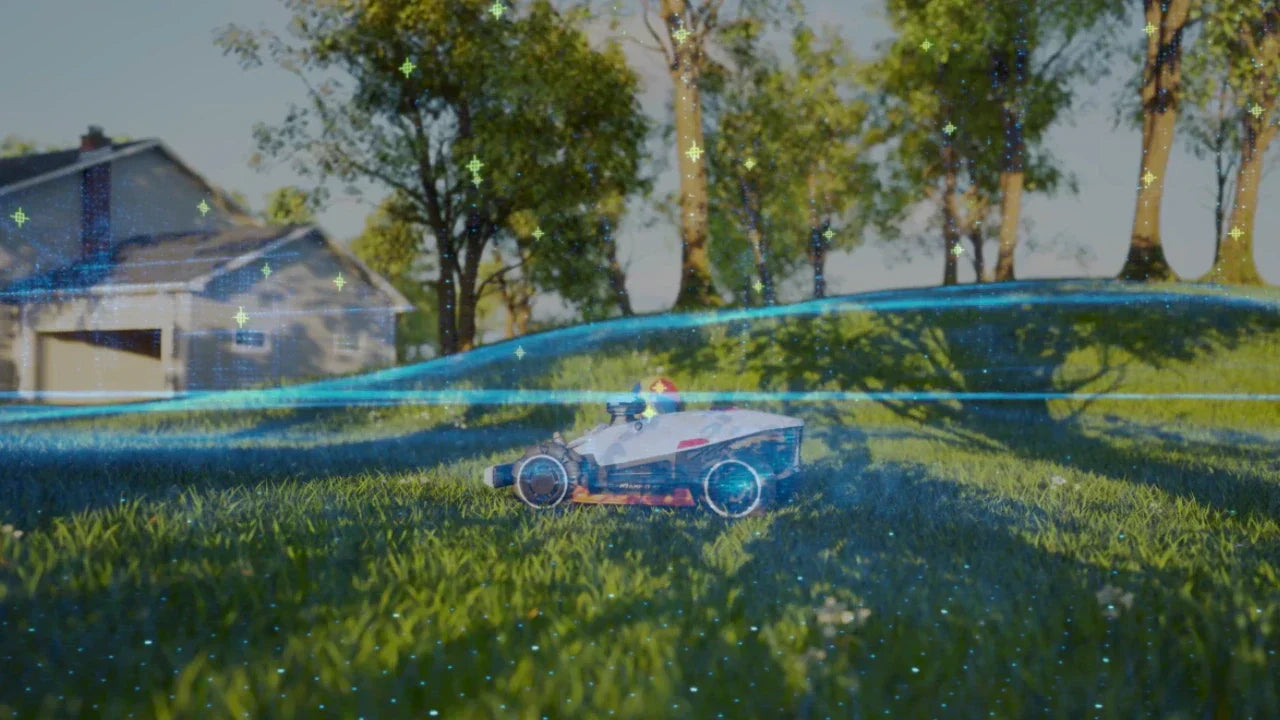
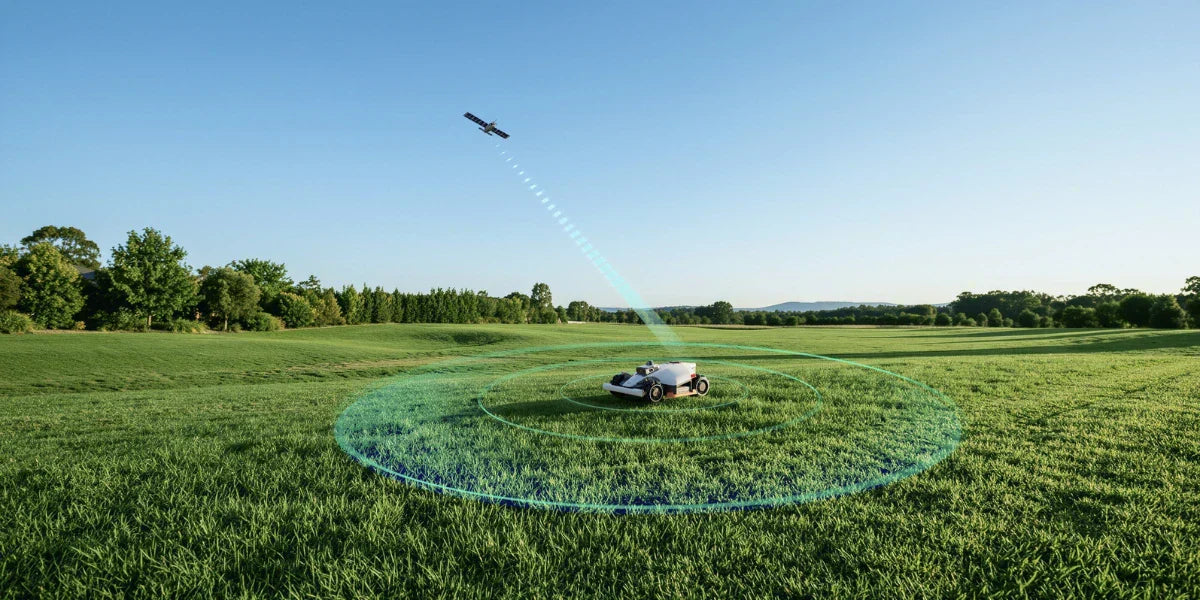
A LiDAR sensor works by emitting thousands of harmless laser pulses per second and measuring the time it takes for those beams to reflect back from surrounding objects such as trees, houses, fences, or rocks.
Using the constant speed of light, the mower’s onboard processor can instantly calculate the precise distance to every nearby object. This allows the machine to generate a highly accurate real-time 3D point-cloud map of its surroundings. Regardless of environmental changes, the mower can maintain centimetre-level positioning accuracy and autonomous navigation.
The three core advantages of LiDAR
1. Perimeter Wire-Free
Users no longer need to spend days digging trenches and installing perimeter wires around the garden. There is also no risk of wire breakage caused by soil movement or gardening work.
Simply guide the mower around the lawn once, and the LiDAR system can map the area by scanning surrounding physical features, enabling a genuine plug-and-play experience.
2. All-Weather Precision
Unlike camera-only robotic mowers that rely heavily on sunlight, LiDAR is an active sensing system with its own light source.
This means its scanning accuracy and obstacle detection performance remain consistent in early morning fog, under strong sunlight with deep shadows, or even in complete darkness at night.
3. Active Obstacle Avoidance
Because LiDAR creates a 3D point-cloud model of the environment, it has highly accurate spatial awareness.
Whether it is a pet suddenly running across the lawn, a garden hose left on the grass, or temporary outdoor furniture, the mower can detect obstacles several metres in advance and smoothly navigate around them — without bumping, pushing, or forcing its way through.
Core technology comparison: LiDAR vs. RTK-GPS vs. AI Vision
To better understand why LiDAR is considered the ultimate solution for complex lawns, the table below compares the three mainstream robotic mower navigation technologies:
| LiDAR | RTK-GPS | AI Vision | |
|---|---|---|---|
| Performance in obstructed environments | Excellent | Poor | Good |
| Adaptability to lighting conditions | Unaffected | Excellent | Good |
| Obstacle avoidance accuracy | Extremely high | Limited | Good |
| Performance on large open lawns | Good | Excellent | Good |
| Best suited for | Complex gardens with trees, landscaping, and narrow passages | Large open lawns with minimal obstructions | Refined gardens with clear boundaries and changing obstacle types |
Conclusion
For gardens with complex landscaping, narrow pathways, and dense tree cover, LiDAR is far more than just another hardware upgrade. It is the key technology that solves the biggest problems of traditional robotic mowers — getting stuck, losing signal, and losing their way.
By giving the mower a true understanding of the 3D physical environment, LiDAR enables centimetre-level mowing precision without relying entirely on satellite signal strength or daylight conditions.
If you are tired of constantly repairing broken perimeter wires, or frustrated by traditional robotic mowers drifting off course under trees and damaging flower beds, a LiDAR robotic mower with multi-sensor fusion technology is one of the most worthwhile upgrades you can make for your garden and lifestyle.
As a leader in all-terrain robotic mowing and wire-free precision navigation, Mammotion has developed a range of flagship robotic mowers equipped with breakthrough 360° LiDAR and multi-sensor fusion technology — designed specifically for complex small, medium, and large gardens.
👉 Explore the full range of Mammotion wire-free robotic lawn mowers and start enjoying a truly automated, blind-spot-free smart gardening experience.



Leave a comment
This site is protected by hCaptcha and the hCaptcha Privacy Policy and Terms of Service apply.