



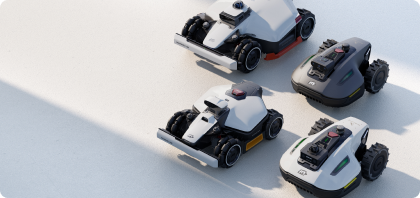

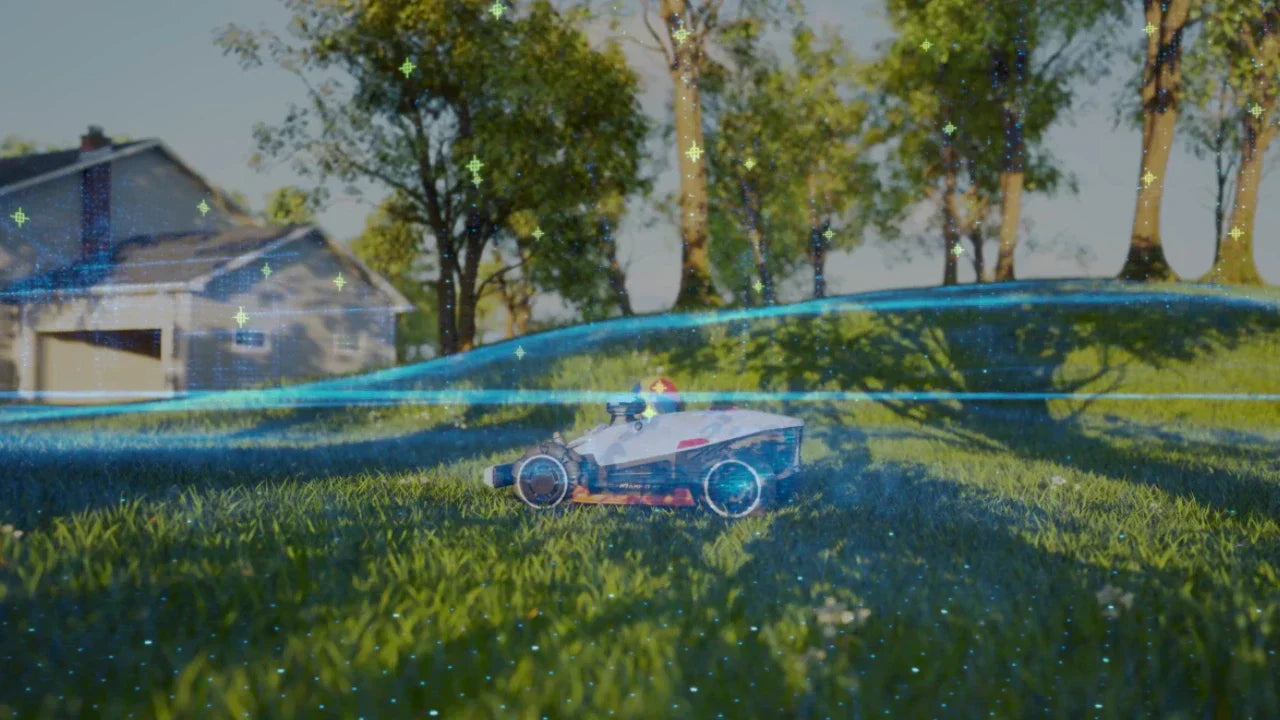
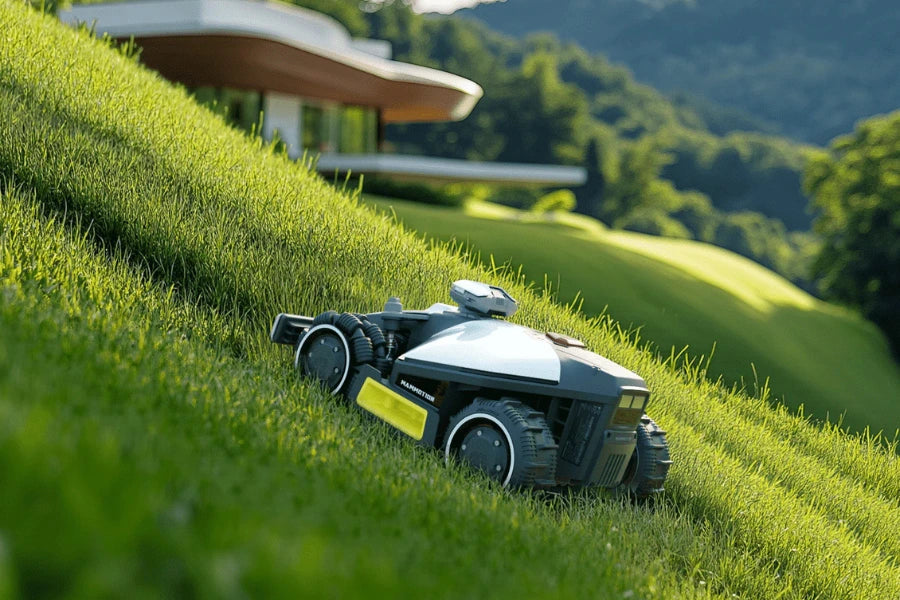
If you’re tired of spending your weekends maintaining the lawn, a GPS robotic lawnmower could be an absolute game-changer for your lifestyle. These autonomous mowers use satellite positioning, base stations, and an array of advanced sensors to "see" your garden and navigate automatically. They take care of everything, letting you completely wave goodbye to the heavy chore of pushing a traditional mower.
In this guide, we’ll skip the overly complex technical jargon and compare the key technologies behind map-making and navigation in today’s modern robotic mowers. You’ll get a clear understanding of how each system works, their unique advantages, and which GPS robotic lawnmower is the perfect fit for your garden.
Part 1: What is a GPS Robotic Lawnmower
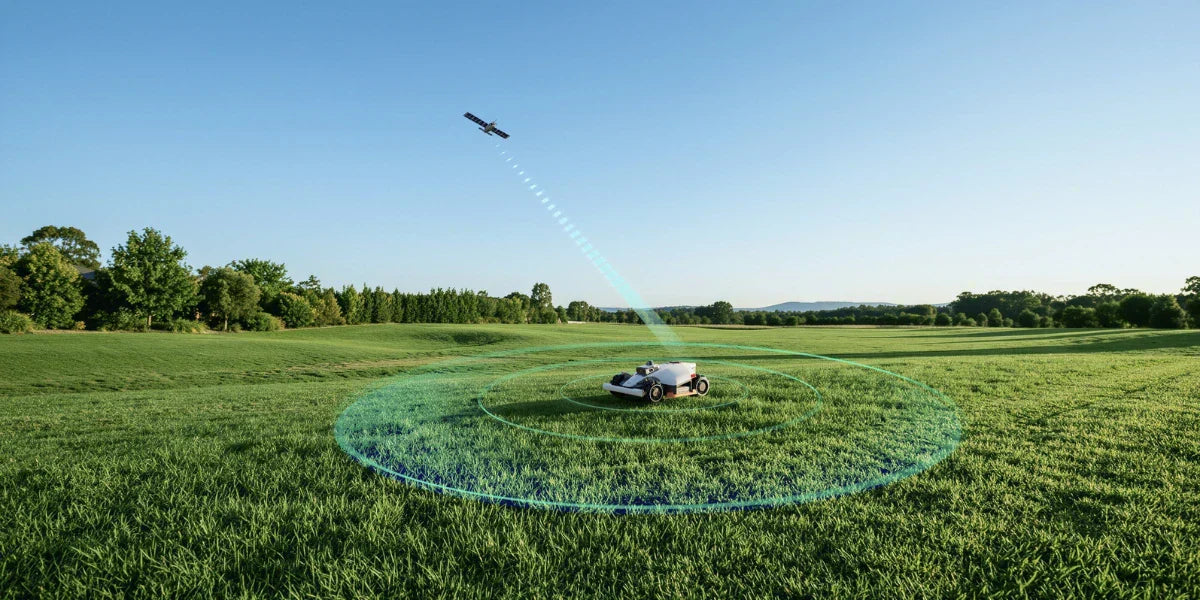
A GPS robotic lawnmower is an autonomous lawn-care device that utilises satellite positioning—often enhanced by high-precision technologies like RTK (Real-Time Kinematic)—to navigate and mow completely without boundary wires.
Unlike traditional robotic mowers that require physical cables buried or pinned along the edges of your lawn, GPS mowers pinpoint their location using GNSS (Global Navigation Satellite System) signals, such as GPS, Galileo, GLONASS, or BeiDou. This is usually paired with a small base station to bring the positioning accuracy down to the centimetre level.
What sets GPS robotic mowers apart from traditional ones
Traditional robotic mowers rely on physical perimeter wires to define the mowing area, which means digging up or pinning cables around your flowerbeds, pathways, and lawn edges. In contrast, a GPS-controlled mower creates virtual boundaries within software—typically via a smartphone app—and then follows this virtual map to mow systematically and efficiently.
In modern systems, the capabilities of a GPS-controlled mower go far beyond simple navigation. This technology enables much smarter mowing patterns, reducing random zigzagging and ensuring better coverage across your garden. When this positioning technology is combined with complementary features like sensors, cameras, or LiDAR, the mower can effortlessly bypass obstacles, adapt to changes in your garden, and even report its precise location and status straight to your smartphone in real time.
Part 2: Comparing Robotic Mower Mapping and Navigation Technologies
Alongside traditional GPS navigation, modern robotic lawnmowers now employ far more sophisticated positioning systems, including LiDAR, AI Vision (cameras), and smart hybrid systems. To choose the right mower for your garden, understanding the differences between these navigation technologies is essential.
| Technology | How does it work? | Advantages | Disadvantages | Best for |
|---|---|---|---|---|
| GPS-RTK | Satellite signals + local base station. | Very accurate without boundary wire. | Can lose signal near trees and buildings. | Open gardens with free view. |
| GPS-NetRTK | Correction data via mobile network. | No visible antenna in the garden. | Requires stable 4G/5G connection. | Minimalist and modern gardens. |
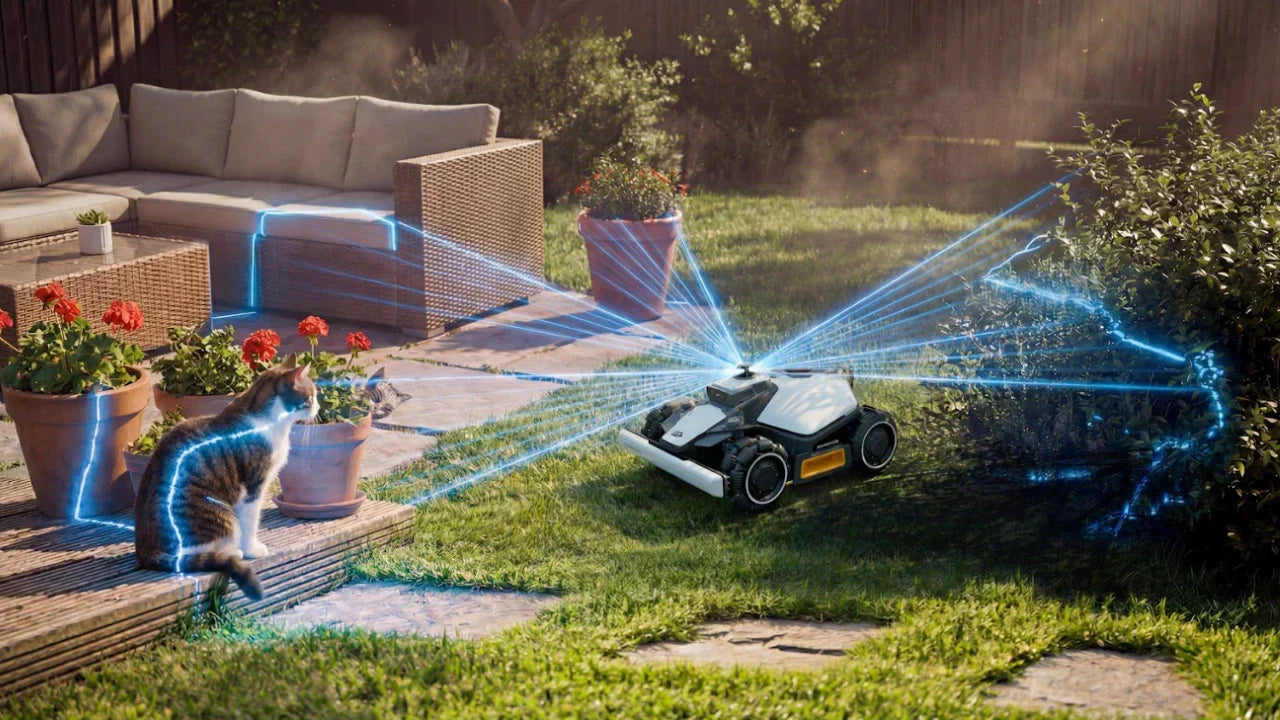
| LiDAR | Laser-based 3D mapping. | Works in the dark and under trees. | Less effective in completely open areas. | Complex gardens with many obstacles. |
| AI Vision | Cameras + AI recognition. | Very good at avoiding obstacles. | Weaker in fog, rain and darkness. | Families with children and pets. |
| Hybrid systems | Combines NetRTK, LiDAR and AI. | Maximum stability and reliability. | Typically more expensive models. | Large and challenging gardens. |
When researching the GPS robotic mower market, you will quickly find that the technology is evolving at a breakneck pace. Traditional GPS-RTK setups, which required a permanent antenna installed in your garden, have now advanced into more streamlined NetRTK technology, where the machine receives correction data directly via the cloud and cellular networks.
However, the most significant trend in 2026 is the introduction of multi-sensor fusion. By tightly integrating satellite navigation (NetRTK) with optical sensors (AI Vision) and laser scanning (LiDAR), manufacturers like Mammotion have created a new generation of robots that almost never lose their way. If your mower drives under a dense chestnut tree and loses its GPS signal, the camera and laser sensors instantly take over. It is this hybrid approach that ensures your lawn receives uninterrupted, highly efficient, and completely worry-free maintenance.
Discover Mammotion Perimeter Wire-Free Robotic Lawn Mowers
Part 3: How to Choose the Best GPS Robotic Lawnmower for Your Garden
Choosing the right GPS robotic lawnmower comes down to matching the robot's technical specifications and features with the actual conditions of your garden. Beyond the navigation technology itself, there are several key performance metrics and functions you should consider. This ensures the machine you invest in will get the job done efficiently and reliably.
1. Terrain, Drive System, and Slopes
The slope and surface conditions of your garden dictate the type of wheels and drive system your mower will need:
- All-Wheel Drive (AWD): If your garden features very steep slopes, deep ruts, uneven terrain, or is frequently muddy and wet, four-wheel drive is indispensable. It provides maximum traction, ensuring the robot doesn't slip or get stuck.
- Rear-Wheel Drive (RWD): For standard, flat, or gently sloping gardens (with inclines up to 45%), rear-wheel drive is usually more than enough. Additionally, it tends to be gentler on delicate turf during tight, sharp turns.
2. Smart Obstacle Avoidance and Safety
A brilliant GPS robotic mower shouldn’t just know where it is; it needs to know what lies ahead. Modern models employ advanced sensors to protect both your garden and the machine itself:
- AI Vision and LiDAR: Models equipped with LiDAR and cameras can detect and steer clear of small objects—like toys, forgotten garden tools, and pets—in real time, rather than bumping directly into them.
- Drop Sensors: If your garden has an unfenced swimming pool, a garden pond, or high patio steps, sensors capable of detecting drop-offs are essential to prevent the mower from tumbling over the edge.
3. Edge Cutting and Passage Width
The layout of flowerbeds, walls, and pathways places high demands on the physical design of the mower:
- Edge Cutting: Look for models with an asymmetric or upgraded edge-cutting disc. The closer the robot can cut to walls and fences, the less time you'll spend manually tidying up with a grass trimmer later.
- Narrow Passages: If your garden is split into different zones connected by narrow tiled walkways or corridors, you should check the mower’s minimum passage width. Some compact models can gracefully navigate through gaps as narrow as 50 centimetres.
4. Automated Mapping and App Control
In 2026, user-friendliness during the setup process has become a major competitive benchmark.
Where you once had to remotely steer the robot around the perimeter via your smartphone, the latest intelligent models offer automated mapping. You simply guide the mower around the garden once, and it automatically scans the layout, detects no-go zones (exclusion areas), and programmes the most efficient mowing routes.
Part 4: The Best GPS Robotic Lawnmowers for 2026
If you want to skip digging miles of perimeter wire or mounting a bulky RTK antenna on your roof, Mammotion’s wireless intelligent mowers are an absolute game-changer, thanks to NetRTK and advanced multi-sensor fusion navigation.
Quick Overview
- Best All-Rounder: Mammotion LUBA 3 AWD
- Best for Medium-Sized Gardens: Mammotion LUBA mini 2 AWD (1000 / 1500)
- Best Value for Small Gardens: Mammotion YUKA mini 2 (800 / 1000)
1. Mammotion LUBA 3 AWD — The Premium Choice for Large Complex Landscapes
As Mammotion’s top-tier flagship model for 2026, the LUBA 3 AWD features a world-first triple-fusion positioning system. This cutting-edge setup seamlessly integrates NetRTK, 360° LiDAR, and dual AI Vision technology, meaning you can ditch both boundary wires and physical RTK base stations in your garden entirely. Whether working on a completely wide-open lawn or tucked under a dense tree canopy, it maintains a rock-solid signal.

Who it’s for:
Garden owners with sprawling lawns, intricate layouts, steep slopes, and hilly terrain—as well as anyone dreaming of a perfectly striped lawn that looks just like a professional football pitch—will absolutely love this machine.
2. Mammotion LUBA mini 2 AWD — The Precision Trimmer for Medium Intricate Gardens
This model is custom-built for detached European homes, where gardens are typically under 1,500 square metres, highly detailed, and divided into distinct sections. Compared to the LUBA 3 AWD 1500, the LUBA mini 2 AWD comes in a more compact size, yet it inherits the heavy-duty All-Wheel Drive system and exceptional terrain adaptability of its larger LUBA siblings.
The standout feature of the LUBA mini 2 is its upgraded, fixed 12-centimetre edge-cutting disc. In our testing, this clever robot hugs house walls and flowerbed borders beautifully, leaving an un-mowed grass strip of only about 5 centimetres. This drastically cuts down on the need for follow-up manual trimming. On top of that, it effortlessly navigates through narrow passages down to just 68 centimetres wide, which is seriously impressive.

Who it’s for:
Homeowners with medium-sized gardens that feature plenty of mature trees, close-set fences, and narrow walkways, who want to keep manual trimming work to an absolute minimum.
3. Mammotion YUKA mini 2 — The Most Budget-Friendly Pick for Small Gardens
The shining star feature of the YUKA mini 2 800 is its revolutionary automated mapping function, which gets the robot configured in less than a minute. You simply guide it around your lawn once, and it automatically recognises the connecting pathways between different zones using its triple-camera AI system and 360° LiDAR scanner. Furthermore, it comes equipped with drop sensors to automatically detect and steer clear of swimming pools, garden ponds, or patio steps.

Who it’s for:
Perfect for small, relatively flat gardens under 1,000 square metres. It is an absolute lifesaver for families with children, where the garden is frequently cluttered with toys, pets, or forgotten items, and it's ideal for anyone looking for the easiest, most user-friendly app setup on the market.
Conclusion
Choosing the right GPS robotic lawnmower comes down to matching the navigation technology with the unique layout of your garden and your personal preferences for setup convenience. No matter which model you choose, a robotic mower equipped with smart mapping is practically guaranteed to save you a wealth of time, while delivering a far more consistent and beautifully manicured finish than a traditional push mower ever could.
FAQ
1. Is GPS the best technology for a robotic lawnmower?
GPS based on NetRTK technology is currently one of the finest solutions on the market, offering centimetre-level precision and a completely wireless installation. It ensures highly structured, efficient mowing routes and easily manages multiple distinct zones across your garden. However, it isn't always a flawless silver bullet; in heavily wooded areas or close to tall buildings, the satellite signal can weaken. In these specific scenarios, a hybrid or camera-based system typically delivers more reliable results.
2. What is the difference between GPS positioning and AI cameras?
The main difference lies in how the two systems perceive and read your lawn. GPS-based mapping utilises satellite signals to determine the robot’s exact coordinates, navigating according to the virtual boundaries you’ve set in your garden. On the other hand, AI Vision mapping relies on cameras and built-in processors to recognise objects, lawn edges, and pathways in real time. Simply put: GPS focuses on raw positioning accuracy, while AI Vision excels at interpreting the surroundings and dynamically dodging obstacles.
3. How do I choose the right mapping technology for my lawn?
The right choice largely depends on the size, layout, and surroundings of your lawn. Wide-open lawns with a clear view of the sky are a perfect match for GPS or RTK systems, whereas heavily shaded, densely treed, or complex landscapes benefit greatly from AI Vision or LiDAR. If you want the easiest possible setup, a wireless solution is infinitely more convenient than traditional perimeter wires. For varied gardens with ever-changing conditions, a hybrid system (combining multiple technologies) will almost always offer the most stable and dependable experience.



Leave a comment
This site is protected by hCaptcha and the hCaptcha Privacy Policy and Terms of Service apply.