



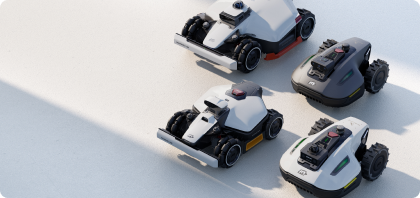





Numerous studies demonstrate that robotic mowing not only saves time and money, but also promotes a healthier lawn through consistent maintenance and fine micro-clippings. However, with the vast array of models on the market, choosing the right one can be overwhelming. Which is better: a robotic lawnmower with or without a boundary wire? This article breaks down how these two technologies work, their technical differences, and their ideal scenarios to help you find the perfect match for your garden.
How Do Robotic Lawn Mowers with Boundary Wires Work
Traditional boundary-wire robotic mowers rely on physical cables installed around the perimeter of your lawn and obstacles. This wire emits a low-voltage signal that the mower's onboard sensors detect to identify its designated working area.

While this system offers reliable operation, the biggest drawback of wired models is the tedious installation process. Pegging down or burying the cables takes significant time and effort. Furthermore, if you change your garden layout, the entire wire configuration must be redeployed. Cable breakages are another frequent pain point; a single wire fault can cause the mower to stop completely, leading to time-consuming troubleshooting.
How Do Wireless Robotic Lawn Mowers Work
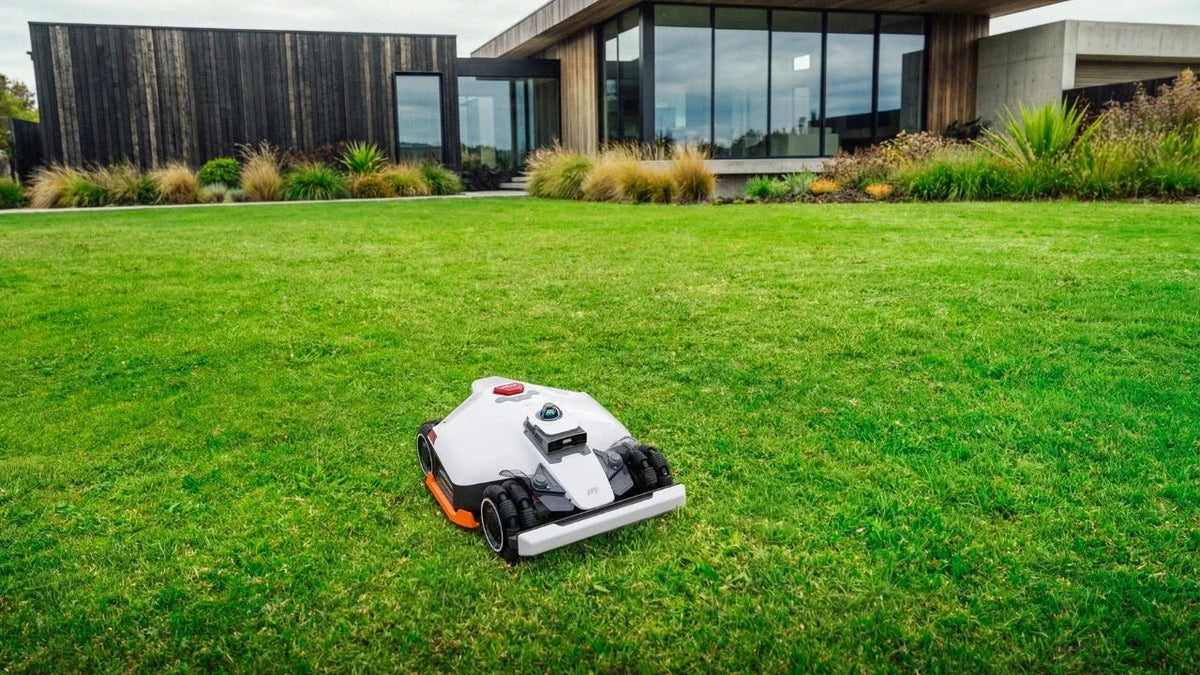
Wire-free robotic lawnmowers eliminate the need for physical perimeter wires entirely. Instead, they rely on advanced satellite navigation and multi-sensor fusion technology to achieve precise, automated mowing across your garden.

Most premium models utilize GPS combined with RTK (Real-Time Kinematic) technology to deliver centimeter-level positioning accuracy, ensuring the mower always knows its exact location on the lawn.
To handle shifting light conditions and complex layouts, many devices further integrate cameras, LiDAR, and AI for real-time obstacle avoidance. Upon initial setup, the mower learns your garden by creating a digital, virtual map, enabling it to recognize property boundaries, trees, outdoor furniture, and varying slopes.
Wired vs. Wireless Robotic Lawnmowers: Key Technical Comparison
To help you make your final decision, we have directly compared the core technologies of wired and wireless robotic lawnmowers.
| Comparison Feature | Wired Robotic Lawnmowers | Wireless Robotic Lawnmowers |
| Installation Method | Requires physical boundary wires | Virtual boundaries via App mapping |
| Navigation Mode | Random bouncing pattern | Intelligent path planning via RTK, AI Vision, and LiDAR |
| Reliability | Stable signal, but high risk of wire breakage | Highly stable signal with centimeter-level precision |
| Flexibility | Extremely low | Very high |
| Price | Budget-friendly | Premium |
| Maintenance | Complex & tedious | Minimal & simple |
| Smart Features | Limited | Advanced & comprehensive |
1. Installation
Boundary-Wire Robotic Mowers
Requires manual laying of physical cables around the entire perimeter of the lawn, as well as around obstacles like trees and stones. The wire can either be secured with pegs on the surface or buried in shallow trenches.

✅Pros:
Relatively simple and straightforward underlying principle.
⚠️Cons:
- The installation process is both time-consuming and tedious.
- Requires invasive physical disruption that can temporarily damage the lawn aesthetics.
- Extremely difficult to alter the layout once the cables are laid.
Wire-Free Robotic Mowers
Operates much like a remote-controlled car. Simply download the manufacturer’s app, connect the machine, and remotely steer it along the edge of your lawn to generate a digital map. Afterward, you can easily customize mowing areas and No-Go Zones directly within the app.
✅Pros:
Zero damage to your turf; fast, effortless installation with maximum flexibility.
⚠️Cons:
Requires placing the RTK reference station in an open area free of major obstructions; otherwise, satellite signals may degrade, leading to positioning drift.
⭐ Tips: Mammotion iNavi service offers lifetime free NetRTK positioning (available on select models), providing an ultra-stable signal without the hassle of installing a physical base station or antenna at home.

2. Navigation Technology
Wired Robotic Mowers: Electromagnetic Pulse Sensors
Relies on sensors located underneath the chassis to detect weak electromagnetic pulses emitted by the boundary wire. As the mower approaches the perimeter, the signal intensifies, triggering a pre-programmed "stop-reverse-turn" random pattern.
✅Pros:
Simple navigation logic that operates independently of satellite signals or ambient light conditions.
⚠️Cons:
- Highly inefficient with uneven cutting results; due to the random bouncing pattern, the mower frequently cuts the same area multiple times.
- Lacks obstacle anticipation; it relies entirely on physical collision sensors, which can scuff expensive outdoor furniture or damage fragile young plants.

Wire-Free Robotic Mowers: Multi-Sensor Fusion Satellite Navigation
Utilizes cutting-edge positioning technologies to shift from random bouncing to intelligent path planning. By integrating Network RTK (centimeter-level precision), 3D LiDAR, and AI vision, the system possesses both "eyes" and a "brain," allowing it to perceive its environment in real time and dodge obstacles flawlessly.
✅Pros:
- Dynamically plans efficient mowing paths, covering the lawn significantly faster than random models while leaving pristine, striped patterns.
- Actively detects and avoids obstacles, safeguarding outdoor furniture, plants, and pets.
- Multi-sensor fusion technology ensures stable, all-weather operation—even under dense tree canopies or near high walls where GPS signals typically weaken.
- Unmatched flexibility; adjust virtual boundaries on the fly directly inside the app with zero manual labor.
3. Performance & Reliability
Wired Robotic Mowers: Stability via Physical Connections
Built on mature, time-tested technology, these mowers offer a "simple but conservative" performance. Because they do not rely on complex satellite data, they remain stable even in heavily shaded environments.
✅Pros:
Exceptional resistance to signal interference.
⚠️Cons:
- Physical cables are highly vulnerable to damage. In regions like Scandinavia, ground frost during winter can cause soil shifting, snapping the buried wires.
- Pinpointing and repairing a wire break requires specialized diagnostic tools, costing significant time and effort.
- Many legacy models are front-wheel drive or underpowered, struggling on steep inclines or slippery, wet grass after rain.
Wire-Free Robotic Mowers: Multi-Dimensional Perception & All-Terrain Power
Engineered with high-precision systems and robust motors, cordless mowers hold a massive advantage when navigating challenging terrains.
✅Pros:
- Master of complex terrains. For instance, the Mammotion LUBA 3 AWD can tackle steep slopes of up to 80% (38.6°)—a feat practically impossible for traditional perimeter-wire models.
- Total freedom from wire breakages. Any minor position drift is instantly corrected via algorithms or visual compensation, requiring no digging.
4. Costs & Maintenance
Wired Robotic Mowers: The Hidden Costs Behind Low Prices
While the upfront purchase price is often highly appealing, the lack of flexibility and ongoing maintenance frequently lead to unexpected expenses. If your garden layout changes, you must purchase new cables and spend hours re-installing them. Over time, the labor cost of diagnosing and uncovering underground faults becomes substantial.
Wire-Free Robotic Mowers: High Premium Yielding Long-Term Peace of Mind
Although wireless robotic mowers require a higher initial investment, their advanced automation capabilities deliver unparalleled long-term value.
- Everything is handled digitally via the app, eliminating the need for digging or paying for professional installation services.
- Routine upkeep is minimal, limited only to cleaning the deck, replacing blades, and running seamless OTA (Over-The-Air) firmware updates.
Should You Choose a Wired or Wire-Free Robotic Lawnmower?
The greatest advantages of boundary-wire robotic mowers lie in their budget-friendly upfront cost and their independence from satellite signals or lighting conditions. However, the installation process is incredibly time-consuming, and tracking down wire breakages during ongoing maintenance can be a massive headache. Furthermore, their random cutting pattern typically results in lower mowing efficiency, less consistent finishes, and a high risk of developing deep, unsightly ruts along the perimeter over time.
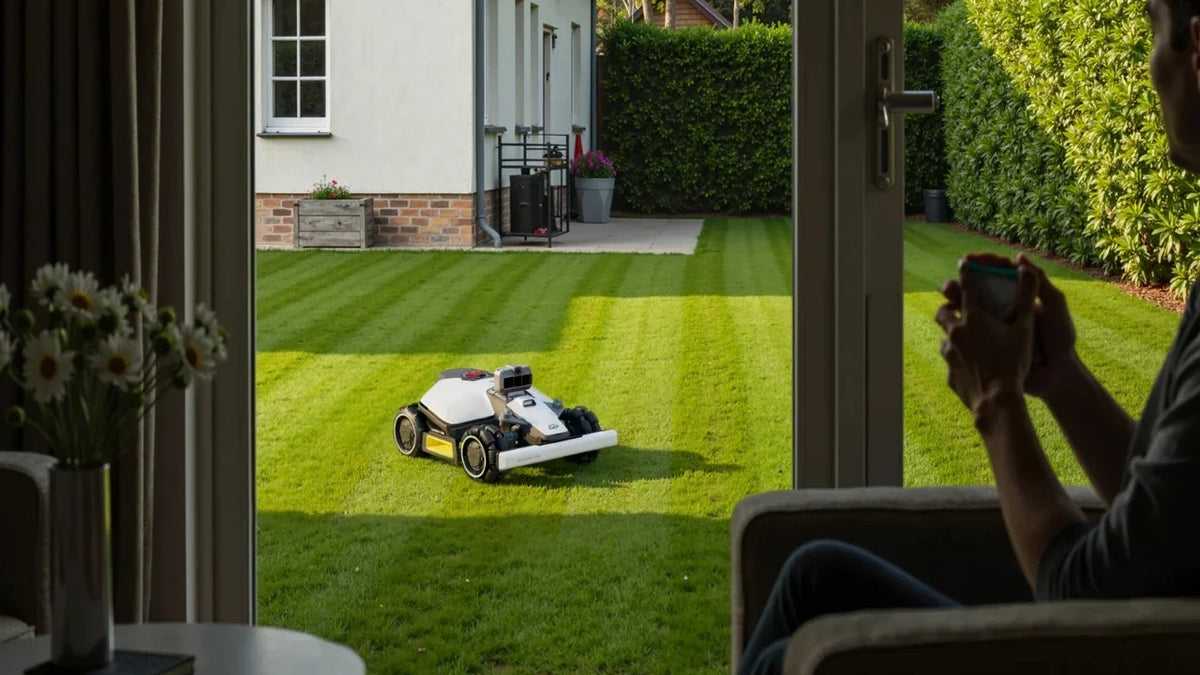
In contrast, wire-free robotic mowers utilize satellite positioning, 3D LiDAR, and AI vision technologies to achieve autonomous, centimeter-level navigation. By eliminating the need to dig up your lawn for cabling, your turf remains perfectly preserved. The lawn is manicured more evenly and beautifully—leaving pristine, professional striped patterns—while the long-term maintenance costs remain significantly lower.
Still unsure which technology is right for you? Use this quick checklist to find your perfect match:
✔️ Choose a Wired Model if:
- Your garden layout is fixed and will not change in the future.
- Your lawn is relatively small, completely open, and features a very simple layout.
- You don't mind spending a few hours upfront laying cables and handling potential wire troubleshooting down the road.
✔️ Choose a Wire-Free (Wireless) Model if:
- You plan to redesign your flower beds, pathways, or landscaping in the future.
- Your lawn features complex terrain, including steep slopes or uneven inclines.
- Your garden layout is intricate, featuring islands, swimming pools, or multiple separate zones.
- You have a medium-to-large lawn (over 500 ㎡).
- You require frequent, high-efficiency mowing to maintain a pristine look.
- You want a true "plug-and-play" smart home solution with minimal effort.
Recommended Wire-Free Robotic Lawnmower
When it comes to wire-free robotic lawnmowers, Mammotion is the undisputed industry leader. Officially certified by Frost & Sullivan, Mammotion has broken records to become the world's leading Perimeter Wire-Free Robotic Lawn Mower Brand.
Ready to upgrade your lawn care routine? Explore our comprehensive wireless robotic lawnmower collection to find the perfect model tailored to your garden's specific size and terrain.
Conclusion
When choosing between robotic lawnmowers, wire-free models hold a massive tactical advantage over traditional wired options, thanks to pioneering navigation technologies like RTK, AI vision, and LiDAR. They offer hassle-free installation, superior mowing efficiency, and unmatched all-terrain performance.
While the initial upfront cost is slightly higher, the seamless, maintenance-free wireless user experience yields far greater long-term value. For European homeowners seeking a perfectly manicured garden without sacrificing their precious time, a wire-free robotic lawnmower is, without a doubt, a forward-looking, smart investment for the future.
Did you like this article? Add us as a preferred source to find us more easily on Google.




Leave a comment
This site is protected by hCaptcha and the hCaptcha Privacy Policy and Terms of Service apply.