



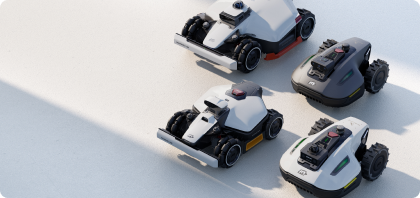

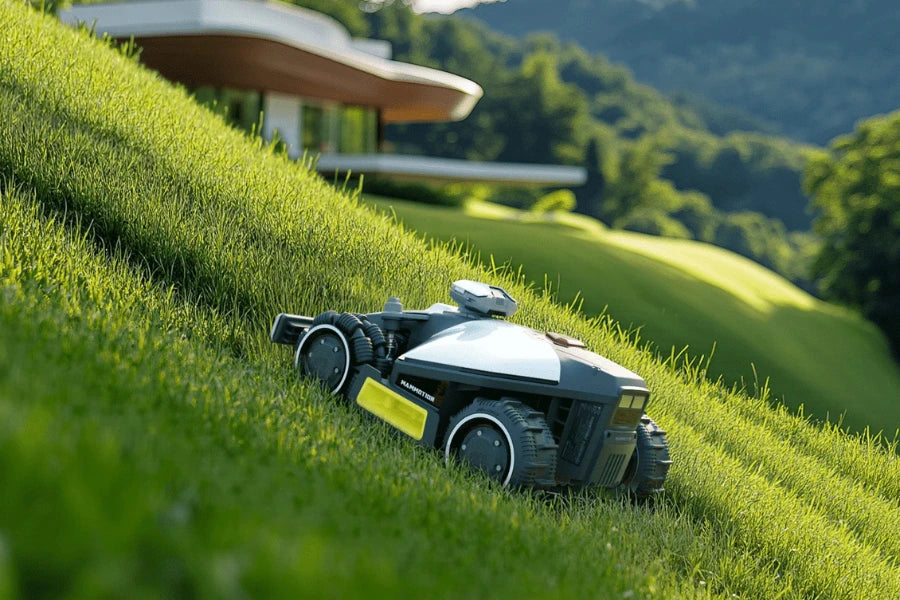
Choosing the right drive system is a crucial but often overlooked step when purchasing a robotic lawn mower. The type of drive has a direct impact on how well the machine handles slopes, uneven ground, and obstacles in your garden. In this guide, we compare FWD, RWD, and AWD robotic lawn mowers, explaining their key differences so you can select the most suitable option for your lawn and maintain a neat, healthy turf with minimal effort.
What are FWD, RWD, and AWD in Lawn Mowers
The terms FWD, RWD, and AWD originate from the automotive industry, referring to how power is distributed to a vehicle's wheels. In the world of robotic lawn mowers, these drive systems determine how the machine moves across your turf.
Depending on where the torque is directed, each system performs differently across various landscapes, offering its own set of advantages and limitations:
- FWD (Front-Wheel Drive) mowers deliver power to the front two wheels, essentially "pulling" the unit forward. These are often the most lightweight and energy-efficient models.
- RWD (Rear-Wheel Drive) mowers are the most common standard in the industry. By directing power to the rear wheels, the robot "pushes" itself across the grass. This configuration is naturally better for climbing because, as the mower moves uphill, the weight shifts to the back, giving the drive wheels better grip and stability on moderate slopes.
- AWD (All-Wheel Drive) mowers provide power to all four wheels simultaneously. This is the premium solution for challenging terrain. Much like a 4x4 off-road vehicle, an AWD robot mower can "crawl" over obstacles and maintain a firm hold on steep banks or slippery grass where two-wheel-drive models would simply slide or get stuck.
Let’s take a closer look at how FWD, RWD, and AWD robot mowers compare in detail.
FWD vs RWD vs AWD Lawn Mowers: Key Differences
Power & Torque
FWD mowers typically provide the lowest torque output. They are designed for lightweight, frequent mowing on well-maintained residential lawns where the grass is kept short and the surface is relatively even.
RWD mowers offer moderate torque with a good balance between power and efficiency. They are generally capable of handling normal garden conditions, including slightly thicker grass or less regularly maintained areas.
AWD mowers deliver the highest torque. Because power is distributed to all drive wheels, they can move a heavier machine across dense grass, rough ground, or larger properties without losing momentum.
Slope Performance
FWD mowers are suitable only for gentle slopes. As the front wheels pull the mower uphill, weight shifts towards the rear, which can reduce grip and cause the wheels to slip on steeper gradients.
RWD mowers perform better on moderate slopes. During a climb, the weight of the battery and chassis naturally presses onto the rear drive wheels, improving traction and allowing the mower to handle inclines of around 25-45% (≈14–25°) under normal conditions.
AWD mowers are best suited for steep terrain. With all wheels driven, traction is maintained even when the surface is uneven or slippery, making it possible to operate safely on gradients of up to around 70–80% (≈35–38°).
Traction & Stability
FWD mowers provide limited traction, especially on uneven or damp grass. Because the front wheels both steer and drive the machine, loss of grip can occur when the surface is not perfectly level.
RWD mowers offer improved stability. As the drive wheels are positioned at the rear, the mower maintains better ground contact when moving forward or climbing, which reduces the likelihood of slipping.
AWD mowers provide the highest level of traction. With power applied to every wheel, the load is evenly distributed, allowing the mower to maintain stable movement even if part of the lawn is wet, uneven, or slightly loose.
Uneven Terrain Handling
FWD mowers are best suited for flat and simple lawns. They may struggle with deep ruts, soft soil, or uneven ground because the front wheels do not provide enough leverage to pull the mower through difficult sections.
RWD mowers can cope with moderately uneven terrain. They usually manage typical garden conditions well, although performance may decrease if one of the drive wheels loses contact with the ground.
AWD mowers are designed for challenging landscapes. Because all wheels are driven, the mower can continue moving even when the surface is irregular, making this drive system more suitable for larger gardens, slopes, or properties with rough ground.
Price Level
FWD mowers are usually the most affordable option. Their simpler mechanical design makes them suitable for small, flat lawns where advanced traction is not required.
RWD mowers sit in the mid-range. They provide a good compromise between performance and cost, which makes them a common choice for typical European gardens.
AWD mowers are positioned in the premium segment. The higher price reflects the more complex drive system, additional motors, and stronger chassis needed to handle steep slopes, uneven ground, and large properties.
RWD vs AWD vs FWD: Which Mower is Right For Your Garden?
1. Flat Gardens and Urban Plots
Recommendation: FWD (Front-Wheel Drive)
Why: For many modern terraced houses or urban semi-detached homes with level, rectangular lawns, an FWD mower is often the most cost-effective choice. Since there are no significant inclines to navigate, the front wheels provide sufficient "pull" to maintain a tidy finish. These models are generally lighter and highly energy-efficient, making them a practical entry-point for straightforward garden layouts.
2. Standard Lawns with Moderate Slopes
Recommendation: RWD (Rear-Wheel Drive)
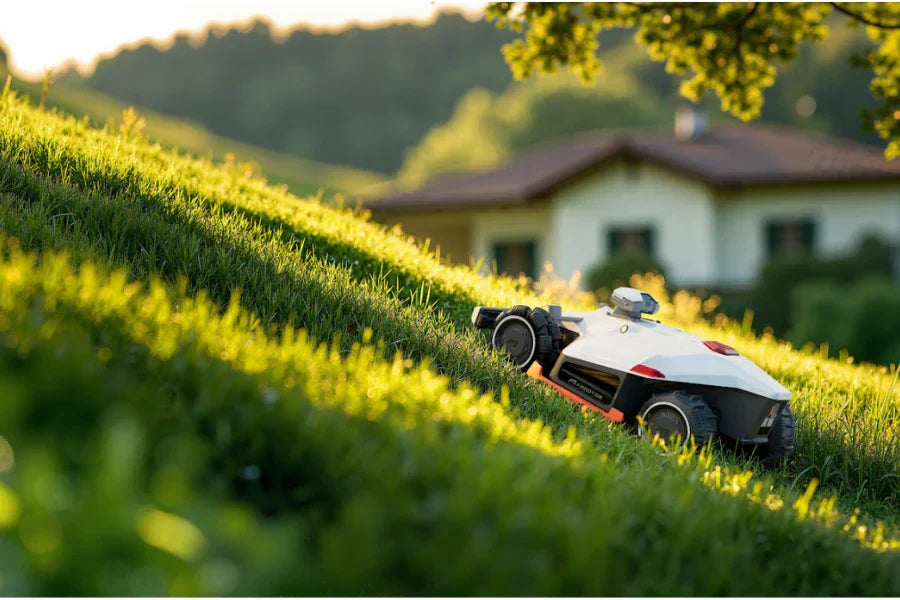
Why: Many suburban gardens in Europe feature natural dips or gentle inclines. An RWD mower is a versatile "all-rounder" for these spaces. Because the centre of gravity typically sits over the rear wheels during a climb, the mower gains extra "bite" into the turf. This helps prevent wheel-spin on moderate slopes (typically up to approx. 20° / 36.4%), offering a more stable performance than FWD models.
3. Sloping, Hilly, or Rugged Landscapes
Recommendation: AWD (All-Wheel Drive)
Why: If you live in a hilly region or manage a larger, unlevel property, an AWD system is highly recommended. These mowers operate with the tenacity of an off-road vehicle; if one wheel loses contact with the ground in a rut or dip, the remaining wheels maintain momentum. They are currently the most capable solution for steep banks. Market-leading models, such as Mammotion LUBA 3 AWD, LUBA 2 AWD, and LUBA mini 2 AWD, can handle slopes up to 38.6° (80%), where two-wheel drive (2WD) lawnmowers may struggle to maintain traction.
4. Damp or Slippery Lawns
Recommendation: AWD (All-Wheel Drive)
Why: In regions with frequent rainfall, such as the UK, Ireland, or Scandinavia, grass can remain damp or mossy for much of the season. AWD provides a significant performance advantage here. Four-wheel traction helps the robot maintain its heading on slick inclines, reducing the risk of "wheel-burn" marks on the turf that can occur when 2WD models lose their grip and spin in place.
5. Complex Garden Layouts
Recommendation: RWD or AWD
Why: For gardens that resemble a "labyrinth" of flower beds, play equipment, and narrow stone paths, agility is key. While RWD models are generally highly manoeuvrable in tight corners, AWD systems excel if those complex areas include uneven transitions—such as moving from a lawn onto a slightly raised gravel path. The consistent torque of an AWD mower helps ensure the robot remains productive and avoids getting "stranded" when navigating tricky boundaries.
RWD vs AWD vs FWD: Quick Comparison Table
| Feature | FWD | RWD | AWD |
| Power Transfer | Front Wheels | Rear Wheels | All Wheels |
| Manoeuvrability | Mediocre | Good | Excellent |
| Traction & Stability | Mediocre | Good | Excellent |
| Slope Performance | Poor | Good | Excellent |
| Terrain Handling | Poor | Good | Excellent |
| Cost | Budget | Mid-range | Premium |
| Best For | Flat city plots and small urban gardens. | Suburban family lawns with moderate slopes. | Steep, rugged estates and hilly landscapes. |
FWD vs RWD vs AWD: Which Robotic Mower is Better?🔥
When choosing a robotic lawn mower, the main comparison is usually between rear-wheel drive (RWD) and all-wheel drive (AWD).
Rear-wheel drive is very common, mainly because the design is simpler and more affordable. Many robotic mowers use RWD, and in most normal garden conditions it offers reliable performance and better traction than front-wheel drive (FWD).
All-wheel drive (AWD), however, is designed for more demanding situations. Because power is delivered to all wheels, AWD models generally provide better grip and stability, especially on larger lawns, uneven ground, or sloped areas. They are often able to handle rough terrain more confidently, although actual performance will always depend on the specific model and lawn conditions.
The more complex drive system usually makes AWD mowers more expensive, but for difficult gardens the extra capability can be worthwhile.
If you are looking for market-leading performance, Mammotion offers a range of intelligent solutions tailored to every garden size and drive requirement.
For Large, Challenging Lawns - Mammotion LUBA 3 AWD
The LUBA 3 AWD is engineered to master medium to large gardens with complex terrains, ranging from 1,500 m² to 5,000 m². With a high-performance cutting efficiency of 500 m²/h, it is capable of maintaining up to 7,000 m² in a single day.

At its heart is the World-First Tri-Fusion Positioning system, which seamlessly integrates 360° LiDAR, NetRTK, and dual-camera AI Vision. This allows the mower to build a real-time 3D map with ±1 cm precision, ensuring stable, 24/7 navigation even in areas with signal interference or low light.
Equipped with four independent drive motors, the LUBA 3 AWD effortlessly conquers steep gradients of around 80% (38.6°) and clears obstacles such as curbs, roots, and thresholds up to 50 mm without getting stranded.
Its all-wheel-drive system ensures a steady mowing line on hillsides, while the omni-wheels allow for precise, smooth pivots that protect your turf and keep the finish looking pristine.
See the best robot lawn mower for steep slopes - LUBA 3 AWD in action:
For Medium-Sized Versatile Lawns - Mammotion LUBA mini 2 AWD
The LUBA mini 2 AWD is specifically engineered for medium-sized gardens with complex layouts, combining a compact chassis with exceptional manoeuvrability.
While more compact than the LUBA 3 AWD, the LUBA mini 2 AWD maintains robust traction. Equipped with four independent motors, conquers steep gradients approaching 80% (38.6°) effortlessly.

Powered by a NetRTK and Triple-Camera AI Vision system, the LUBA mini 2 AWD ensures centimetre-level navigation even in low light or areas with weak satellite signals.
Using NetRTK via Mammotion iNavi Service, there is no need for a physical RTK base station or complex installation; simply connect the mower to your network and begin.
To ensure a pristine finish right up to the boundary, the LUBA mini 2 AWD features a 120 mm fixed edge-cutting disc. This allows for safe, precision trimming within approximately 5.5 cm of walls and obstacles, significantly reducing the need for manual edge maintenance.
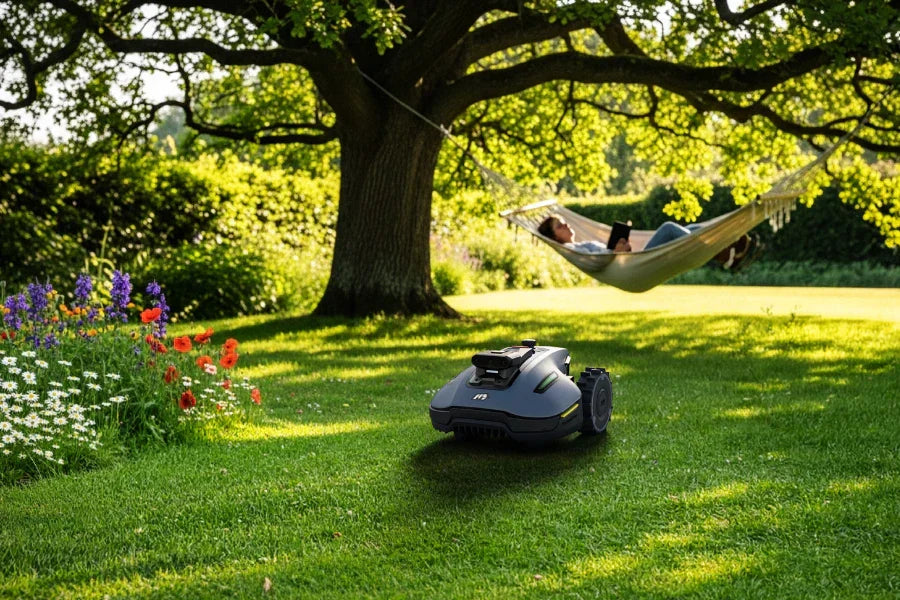
For Small to Compact Gardens - Mammotion YUKA mini 2
YUKA mini 2 is the best robotic mower for smaller gardens. Equipped with a large-diameter rear wheel and a powerful 65W hub motor, its well-designed body and optimized center of gravity allow it to easily navigate small potholes and low-hanging branches without getting stuck or tipping over.
It reliably handles gradients of around 45% (24°), maintaining consistent traction even on undulating or uneven turf without the risk of wheel-slip. It can easily pass through narrow passages as narrow as 55 centimeters.
Explore more and shop Mammotion cordless robotic mowers.
FAQ
1. Are AWD lawn mowers worth it?
Yes, AWD mowers are worth the investment if your garden features gradients exceeding 20° (35%) or uneven, "bumpy" terrain. The multi-motor system prevents the mower from getting stuck or sliding, saving you from manual interventions and protecting your turf from wheel-burn marks.
2. Is AWD much better than RWD?
AWD is significantly better than RWD for climbing performance and stability on slippery surfaces. While RWD is sufficient and more energy-efficient for standard residential gardens, AWD offers the necessary torque to navigate thick grass and complex landscapes that would cause a 2WD mower to struggle.
3. What slope needs AWD?
You generally need an AWD robotic mower for any slope exceeding 20° to 24° (approx. 35%–45% gradient). While RWD models can manage moderate inclines, AWD is essential for maintaining a steady line on steep banks or "hilly" gardens, especially in damp conditions where traction is limited.




Leave a comment
This site is protected by hCaptcha and the hCaptcha Privacy Policy and Terms of Service apply.