









Lawns require a substantial supply of nutrients, and fertilising in spring is essential for keeping your grass dense, vigorous, and richly green. If you’re wondering when is best time to fertilize lawn in spring, how to fertilize properly, and which fertiliser to choose, Mammotion will guide you through the key steps.
The benefits of fertilising in spring
The most immediate benefit of spring fertilisation is that it reactivates lawn growth. After a long, cold winter, the nutrient reserves stored in the roots are largely depleted. As soil temperatures begin to rise, the lawn enters a new growth cycle. Applying an appropriate amount of nitrogen at this stage increases chlorophyll production in the leaves. This not only restores a healthy green colour, but also accelerates the repair of damaged blades, helping the lawn quickly fill the gaps left by winter.
Spring fertilisation also helps suppress weeds and moss. Many weeds and moss species become active at relatively low temperatures. By stimulating faster grass growth, fertilisation increases turf density per square metre. Once the lawn forms a thick, even sward, less light reaches the soil surface — which reduces weed seed germination and limits moss spread.
In addition, spring feeding prepares the lawn for summer stress. Moderate applications of phosphorus (P) and potassium (K) support deeper root development. A well-developed root system can draw moisture from deeper soil layers, which directly improves drought resilience later in the season.
In short, spring fertilisation lays the foundation for healthy growth throughout the year.
When to fertilise your lawn in spring
Spring is the most important fertilising period of the year. The first application should take place when the lawn begins producing fresh growth after winter dormancy, typically from late March to mid-April in much of Northern and Central Europe.
A simple indicator: if you notice visible growth within a week after mowing, the lawn is actively growing again. Fertilising at this stage ensures that nutrients are absorbed directly by the growing blades rather than remaining unused in the soil.
💡Further Reading: How often should you mow your lawn
Which spring lawn fertiliser should you use
Grass requires three primary nutrients: nitrogen (N), phosphorus (P), and potassium (K). Nitrogen is the key driver of spring recovery and colour.
Fertiliser packaging displays the NPK ratio (nitrogen–phosphorus–potassium). In spring, choose a formulation with a higher nitrogen proportion to encourage rapid greening and leaf growth.
Choose according to your needs:
- Slow release lawn fertiliser (controlled release) – This is generally the most recommended option. Nutrients are released gradually, typically providing 2–3 months of steady feeding. It delivers gentle, consistent growth, reduces the risk of scorch, and minimises the number of applications required.
- Fast-acting fertiliser – If your lawn is severely discoloured and needs rapid improvement, a quick-release fertiliser can provide visible results sooner. However, it leaches more easily and can scorch grass if overapplied or not watered in properly.
- Moss-control fertiliser – If moss has developed over winter, choose a spring fertiliser containing iron sulphate (FeSO₄). This both feeds the lawn and effectively suppresses moss growth.
How to fertilise your lawn properly
Before fertilising, clear the lawn thoroughly. Remove leaves and debris, and rake out any thatch build-up. If the soil is compacted, aerate lawn first to improve nutrient penetration to the root zone.
Apply fertiliser evenly and lightly across the entire lawn. Always follow the dosage instructions on the packaging — typically around 2–3 kg per 100 square metres. A spreader is strongly recommended, especially for larger areas. Hand broadcasting rarely achieves uniform coverage and can result in uneven growth. For best results, apply in a criss-cross pattern (lengthways, then crossways).
Water immediately after application. Moisture dissolves the granules and carries nutrients into the soil. If fertiliser remains dry on the grass blades, sunlight can trigger chemical reactions that scorch tender leaf tips. Applying fertiliser just before rainfall or during light rain is ideal. Organic fertilisers are less likely to cause scorch and can be applied in various conditions, but they still require moisture to decompose and penetrate the soil.
Fertilising your lawn with Robotic Mower
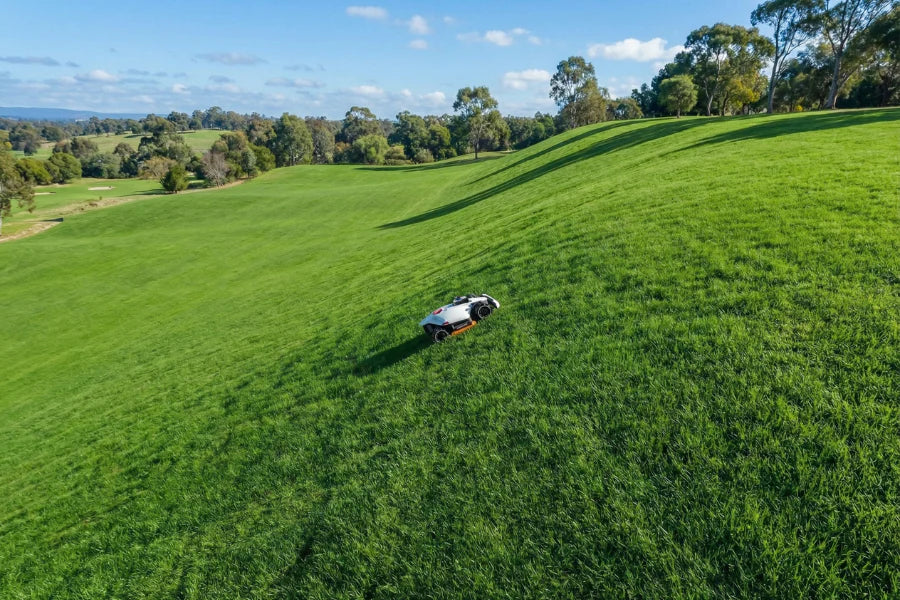
Using a robotic mower is, in fact, a simpler and highly efficient form of natural fertilisation.
Robotic mowers operate with high-frequency, light trimming. The clippings produced are extremely fine and fall directly to the soil surface around the grass roots. These clippings are rich in nitrogen and, under the action of soil microorganisms, decompose quickly into a steady, natural nutrient source.
Compared with synthetic fertilisers, these organic nutrients — derived directly from your own lawn — are absorbed efficiently and create a closed nutrient cycle within the garden ecosystem.
In the field of sustainability, Mammotion continues to lead the industry. The Mammotion LUBA 3 AWD received the 2026 SEAL Sustainable Product Award. The Mammotion LUBA 3 AWD is the only robotic mower to have received this distinction since the award’s inception.

Choosing the LUBA 3 not only frees you from time-consuming lawn maintenance, but also supports a greener, lower-impact lifestyle — maintaining a healthy, vibrant garden with reduced reliance on excessive chemical inputs.

Practical spring fertilising tips
- In spring and early summer, choose a slow-release fertiliser with higher nitrogen content to promote rapid greening and strong leaf growth.
- In autumn, switch to a low-nitrogen, high-phosphorus and potassium formulation to strengthen roots and improve winter hardiness.
- Apply fertiliser before rainfall or during light rain whenever possible to ensure even nutrient distribution and prevent leaf scorch.
- Use a spreader for consistent coverage and to avoid uneven colour patches.
- Fertilise 2–3 times during the growing season. Smaller, regular applications support steadier growth than one heavy treatment.
- Use a robotic mower for natural fertilisation. For example, the Mammotion LUBA 3 AWD produces fine clippings through frequent mowing, which biodegrade and continuously replenish nitrogen in the soil.
FAQ about spring lawn fertilising
When should I apply the first fertiliser in spring?
The first application should take place when the lawn begins producing fresh shoots after winter dormancy — typically from late March to mid-April across much of Northern and Central Europe.
A practical rule of thumb: if you see noticeable growth within a week after mowing, the grass has resumed active growth. Fertilising at this point ensures nutrients are absorbed directly by growing blades rather than remaining unused in the soil.
When should I use a high-nitrogen “super lawn” fertiliser in spring?
For high-nitrogen fertilisers, the ideal window is April or early May. As temperatures rise, the lawn enters a vigorous growth phase and its nitrogen demand increases. Applying nitrogen at this stage maximises leaf density and promotes a rich green colour.
Does it have to rain when fertilising?
No — but applying fertiliser just before rainfall is ideal. Rainwater naturally dissolves the granules and carries nutrients down to the root zone.
If no rain is expected, you must water thoroughly within 24 hours after application. Otherwise, fertiliser particles left on the leaf surface can cause chemical scorch.
How early can I fertilise in spring?
You may fertilise once the ground has completely thawed and there is no remaining snow cover. However, fertilising too early is ineffective. If soil temperatures are below 8°C, roots remain semi-dormant and cannot absorb nutrients efficiently. In such cases, nutrients are likely to leach away with rainfall.
It is advisable to wait until the lawn begins naturally greening before applying fertiliser.
Which months should I avoid fertilising?
In Northern and Central Europe, high-nitrogen spring and summer fertilisers should not be applied from September to early November. Fertilising during periods of frozen soil in winter should also be avoided.
Late nitrogen applications stimulate tender new growth that is vulnerable to frost damage.
Should I seed or fertilise first in spring?
Fertilise immediately after seeding. The typical sequence is:
- Scarify (or vertical cutting) and aerate
- Sow the seed
- Apply fertiliser
- Water thoroughly
This ensures nutrients are available as soon as germination begins.
What happens if I over-fertilise the lawn?
Excess fertiliser can cause fertiliser burn, visible as yellow or brown scorched patches. This occurs because high salt concentrations draw moisture out of plant tissue.
Over-fertilisation may also:
- Reduce disease resistance
- Disrupt soil pH balance
- Contribute to nutrient runoff, polluting nearby water sources
Precise application rates are essential for both lawn health and environmental protection.
Summary
Spring is the pivotal season for lawn care. By fertilising accurately at the onset of growth and supporting a natural nutrient cycle with a robotic mower such as the Mammotion LUBA 3 AWD Robot Lawn Mower, you can cultivate a dense, healthy, and sustainable green lawn with minimal chemical intervention.
Did you like this article? Add us as a preferred source to find us more easily on Google.


Leave a comment
This site is protected by hCaptcha and the hCaptcha Privacy Policy and Terms of Service apply.