



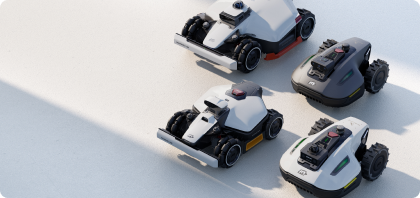





Maintaining a perfect lawn on challenging terrain requires the right tools and expertise. Discover how to safely mow a steep hill and achieve a professional finish on even the most sloped banks.
The Challenges of Mowing a Steep Hill
Mowing a flat lawn is a straightforward task, but once you encounter an incline, the complexity increases significantly. Maintaining a lawn on a hillside presents several unique hurdles that go beyond mere physical effort:
Safety Risks and Stability
Standard mowers is often not designed for high-incline stability, leading to a high risk of the mower tipping or rolling over. On a steep bank, the shift in the centre of gravity can cause a loss of steering control or braking power, posing a serious threat to the operator.
Optimal Mowing Results and Tool Selection
Achieving a professional, uniform finish on a hilly lawn is notoriously difficult. The primary issue is "scalping"—where the mower blades cut too close to the soil on mounds or ridges, leaving unsightly brown patches. Conversely, dips in the terrain often result in patches of long, uncut grass.
Traditional mowers often lack the specialized traction or adaptive suspension required to follow the contours of a steep slope, making the choice of machinery the deciding factor between a manicured oasis and a patchy mess.
Mechanical Strain
Engine Lubrication: Many petrol engines rely on splash lubrication, which can fail when the mower is tilted at an angle, leading to catastrophic engine seizure.
Traction Loss: Two-wheel-drive systems frequently spin their wheels, damaging the delicate turf and leaving "burn marks" on the grass.
Battery and Motor Strain: Climbing a steep bank requires maximum power output, which can lead to overheating and a significantly reduced lifespan for both electric and petrol-powered models.
Essential Guidelines for Mowing Steep Slopes
Mastering the art of hillside maintenance requires a combination of vigilance and the right approach to ensure both your safety and the health of your turf.
- Never attempt to mow a steep bank when the grass is wet. Damp turf significantly reduces traction, increasing the risk of the mower sliding and making slips or falls much more likely.
- Before starting, assess the steepness. Most standard mowers are not rated for slopes exceeding 15 or 20 degrees.
- For Push Mowers, Mow Across, Not Up and Down. This prevents the mower from rolling back onto you or pulling you downhill if you slip.
- For Ride-on Mowers, Mow Up and Down. If you are using a ride-on mower or lawn tractor, always drive straight up and down the hill to prevent the machine from tipping sideways.
- Clear the Area. Steep slopes often hide debris like rocks or fallen branches in tall grass. Clear the path beforehand to prevent dangerous projectiles or damage to your blades.
- Wear sturdy boots with deep treads to maintain your footing. Avoid mowing in trainers or sandals.
- Set your blades higher than usual for the first pass. This prevents "scalping" the uneven ridges often found on banks and protects the root system of the grass.
Pro tips: Measuring slope with your phone
Download a level app on your phone (iPhone comes with the "Measure" app). Find a straight wooden board about 1-2 meters long and place it flat on the slope. Place your phone on the board and read the value.
Mowing Steep Hills: Tips for Every Mower
The following tips explain how to optimally cut grass on steep hills and slopes for common mower types.
1. Mowing on a steep hill with a robot mower
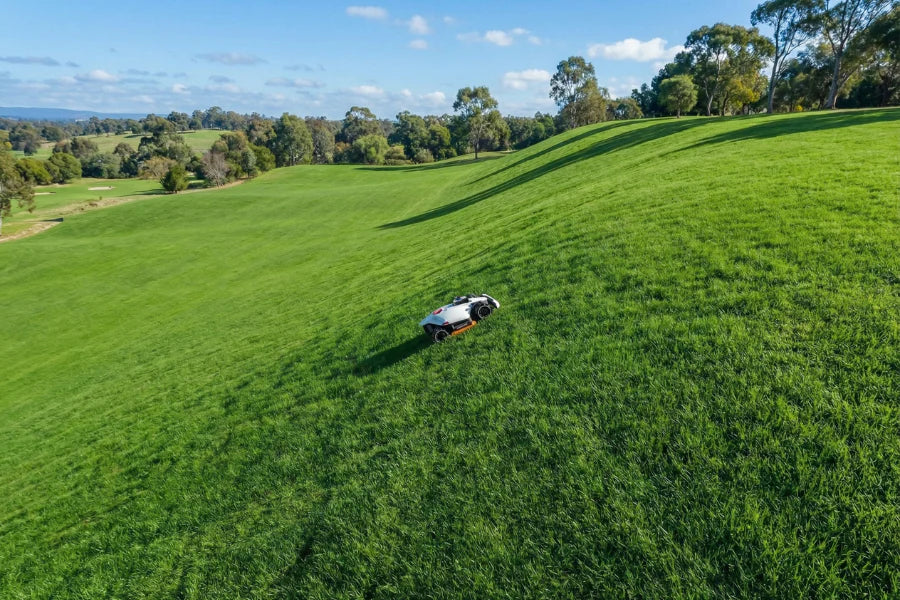
Modern automation is transforming the way we manage challenging landscapes, allowing homeowners to delegate dangerous and time-consuming tasks to intelligent machinery. A standout solution is the Mammotion LUBA 3 AWD series, engineered to conquer slopes of up to 80% (38.6°).

Several industry-leading features designed specifically for steep and rugged terrain:
- All-Wheel Drive (AWD) Mastery: Provides superior traction to prevent slipping and protects the delicate turf from "wheel burn" damage.
- Advanced Suspension System: Ensures the chassis remains stable and follows the ground contours precisely on uneven banks.
- Adaptive Cutting Height: Automatically manages a range of 25–70mm, ensuring a professional finish even on undulating ground.
- Dual 165W High-Torque Motors: Delivers the necessary power to maintain consistent blade speed while climbing.
- 3-in-1 Fusion Navigation: The world's leading system combining 360° Radar, NetRTK, and Binocular AI Vision for reliable, wire-free operation even in areas with poor satellite coverage.
With its powerful performance, eliminating the need for manual labour and complex boundary wiring, the LUBA 3 AWD represents the best robot lawn mower for safely mowing steep slope lawns.
2. Mowing on a steep hill with a riding mower
When using a riding mower or lawn tractor on inclines, safety must be your absolute priority. It is generally recommended to avoid slopes exceeding 10° (17.6% gradient). Always operate the machine straight up and down the face of the slope; never drive across the incline, as the high centre of gravity makes these machines highly susceptible to tipping sideways.
Maintain a steady, controlled pace and avoid any abrupt turns, sudden braking, or rapid changes in speed. For optimal handling, especially on steeper sections, ensure the grass collector is emptied more frequently than usual to maintain a balanced weight distribution. Should the wheels begin to lose traction, immediately disengage the cutting blades and drive slowly and directly down the hill.

3. Mowing on a steep hill with a push mower
Mowing on a steep slope with a push mower is extremely strenuous.
When using a push mower, you must mow horizontally (across). This ensures that even if you slip, the mower will stay to your side instead of rolling over you.
It is recommended to start from the bottom of the slope. This ensures the mower always turns uphill, preventing loss of control due to acceleration while turning. To minimize the risk of slipping, only mow on slopes when the grass is dry.

FAQ: Mowing on Hills and Steep Banks
How to mow a 20 degree slope?
A 20-degree slope (approximately a 36% gradient) is considered steep and exceeds the safety limit for most standard ride-on mowers. To mow it safely, use a self-propelled push mower and move horizontally across the face of the slope. However, for the most efficient and safest result, an AWD robotic mower like LUBA 3 AWD, LUBA mini 2 AWD are ideal, as they remove the risk of operator slips or equipment tipping.
How to mow a hill without scalping?
Scalping occurs when the mower blades cut too close to the soil on ridges or mounds. To avoid this, raise your cutting height to 60–70mm for sloped areas. Additionally, using a mower with an adaptive suspension system or a floating deck allows the blades to follow the natural contours of the hill, ensuring a consistent finish without baring the soil.
Should you mow uphill or downhill?
If you are using a lawn tractor or riding mower, you should always mow straight up and down the hill to maintain stability and prevent tipping. If you are using a manual push mower, the safety standard is to mow across the slope (perpendicular to the incline). This ensures that if you slip, the mower will not roll over you.
What is the easiest way to cut grass on a steep hill?
The easiest and most modern method is using a automated robotic lawn mower, like LUBA 3 AWD series, which can navigate steep banks autonomously, providing a professional-grade cut while you relax.
How steep is a 20% incline?
In garden terms, a 20% incline is equivalent to an 11.3-degree angle. This is a moderate slope. The following are common slopes and their corresponding angles:
| 20% | 11.3° | Gentle slope |
| 30% | 16.7° | Moderate slope |
| 45% | 24.2° | Steep slope |
| 70% | 35° | Very steep slope |
| 80% | 38.6° | Extreme slope |
| 100% | 45° | Maximum practical slope |
Summary
We hope this guide has given you the confidence to identify the right techniques and technology for your terrain. Whether you choose to refine your manual technique or invest in a robot mower, the goal is the same: to sit back and enjoy your green oasis, knowing your lawn is in safe, capable hands.
Did you like this article? Add us as a preferred source to find us more easily on Google.


Leave a comment
This site is protected by hCaptcha and the hCaptcha Privacy Policy and Terms of Service apply.